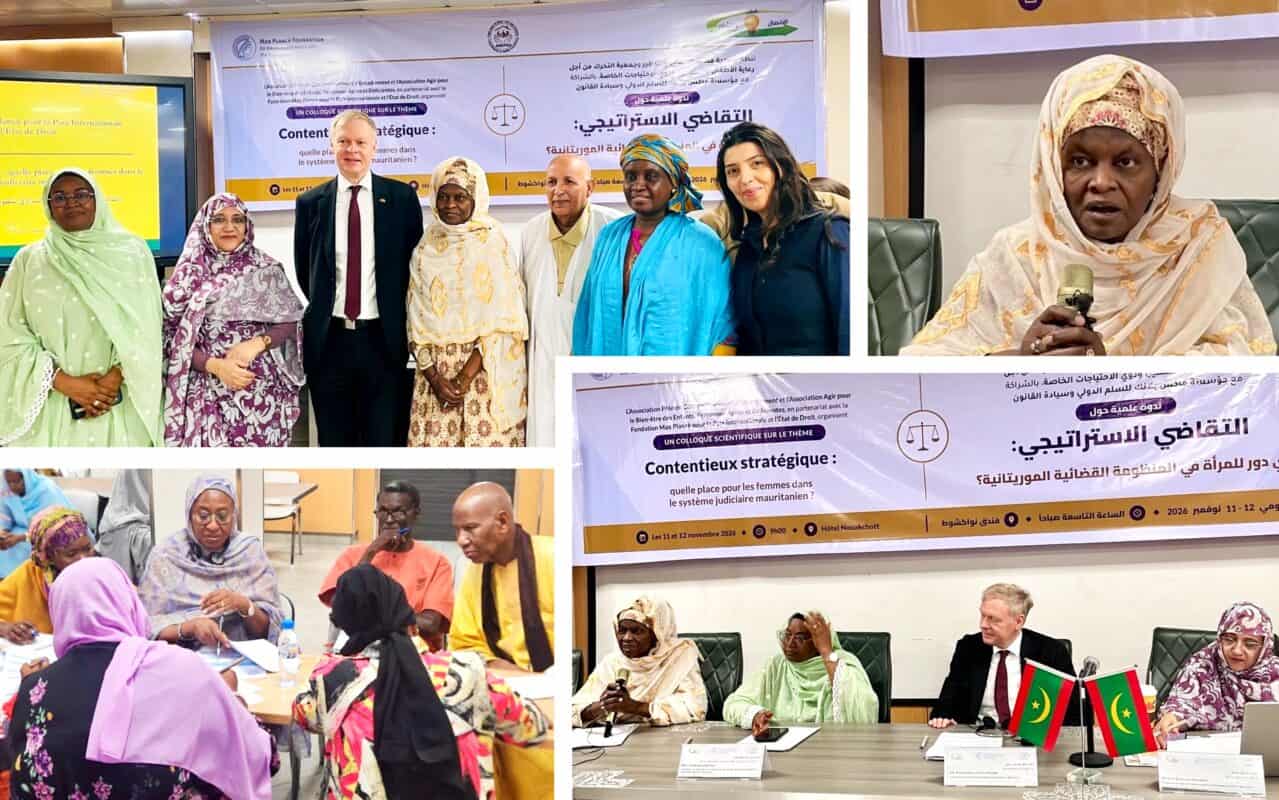
On 11 and 12 November 2026, the Max Planck Foundation for International Peace and the Rule of Law convened a two-day workshop in Nouakchott under the title ‘Strategic Litigation: What Role for Women in the Mauritanian Judicial System?’. The event formed part of the project ‘Strengthening the Reach and Accessibility of Constitutional Justice in Mauritania’, funded by the German Federal Foreign Office, and gathered some 40 participants, among them academics, lawyers, civil society representatives and other stakeholders.
The workshop opened on 11 November 2026 with welcoming addresses by H.E. Dr Florian Reindel, Ambassador of the Federal Republic of Germany to Mauritania; Dr Oum Kalthoum Hamedinou, Head of the Communication and Mentoring Organisation (PCE); and Ms Yande Sall, Head of the organisation ‘Acting for the Wellbeing of Children, the Elderly and the Disabled’ (ABEPAD). The opening session was also attended by Ms Fatimata M’baye, a leading human rights activist, founder of the Mauritanian Human Rights Association and the country’s first female lawyer. Her presence underlined the importance of the workshop for women’s rights organisations throughout Mauritania.
Over the two days, a series of presentations drew on comparative perspectives and case studies, followed by an interactive working group session. Speakers examined the concept and origins of strategic litigation and its potential for systemic change, relevant African jurisprudence, criteria for selecting strategic cases, and approaches to identifying and documenting violations of women’s rights as a basis for litigation. Mauritanian experts and civil society representatives discussed the obstacles to implementing the legal aid framework, which could serve as a vehicle for strategic litigation, as well as the difficulties surrounding the adoption of the draft law to strengthen the protection of women against violence. Further discussions addressed women’s right to alimony and the practical steps required to make this right effective.
In the working group session, participants developed concrete recommendations for civil society organisations on how to overcome the various barriers to the effective protection of women’s rights. They considered how different advocacy tools, including strategic litigation, could be used to advance these goals.
The workshop closed with remarks by Ms Sall (ABEPAD), Dr Hamedinou (PCE) and a representative of the Max Planck Foundation. Both Mauritanian speakers stressed the value of capacity-building for civil society organisations in enabling them to better support women in asserting and defending their rights. They also thanked the Max Planck Foundation and the German Federal Foreign Office for their ongoing commitment to strengthening women’s rights in Mauritania.