
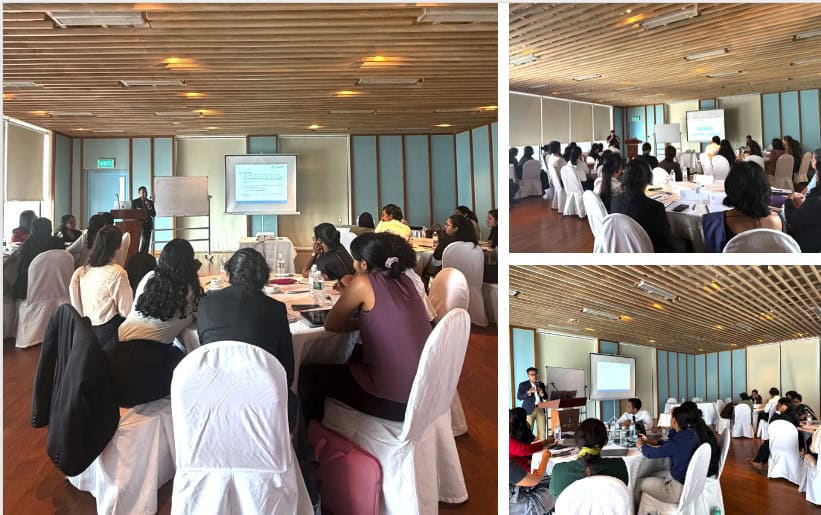
Held from 10 to 11 August 2026, the workshop focused on key skills for judicial research officers (judicial clerks) in performing their roles.
This two-day workshop brought together thirty-five judicial research officers (JROs) of judges of the superior courts to develop key skills required for their roles, discuss ethical considerations surrounding their work, identify opportunities for coordination and share comparative experiences from jurisdictions where the role is more institutionalised.
The workshop broadly followed the style and structure of the first workshop conducted by the Foundation in 2024, with new sessions on the administrative processes of superior courts, on critical legal reasoning skills, and a collective exercise of identifying spaces for coordination and collaboration amongst the JROs.
Day 1 of the workshop opened with an introductory session in which the participants reflected on the nature of their work and were introduced to different models of the role in other apex courts. In the second session, the Registrar of the Supreme Court discussed the administrative processes in the superior courts as they relate to JROs and explored how JROs fit into the broader system of administration of justice.
This session was followed by two skills sessions focused on legal research and legal writing. The research session covered developing a research strategy, navigating databases and the use of comparative and international jurisprudence. The writing session focused on guidance on legal writing based on a pre-workshop exercise shared with the participants. The pre-workshop exercise required the participants to read mock court documents and draft a research memorandum, an entry on the mock case for a bench memorandum, and an outline of a draft judgment, both with and without the use of Artificial Intelligence.
The next session was a highly interactive session on critical legal reasoning, where the Supreme Court and Court of Appeal JROs engaged in groups and then in plenary to discuss, debate and resolve a legal issue presented to them.
The final substantive session for the day was a participatory and reflective session that explored the different practical ethical considerations arising from the work of a JRO. The day ended with an exercise where participants worked in groups to research a legal issue and submit a memorandum, which was reviewed the next day by resource persons.
On Day 2, two substantive sessions were focused on the review of judgments prior to delivery. Following this, the Supreme Court and Court of Appeal JROs engaged in an extended group exercise to review mock draft judgments from the two courts, respectively. The day closed with an interactive session where the participants identified spaces for colloboration and coordination in their work as JROs.
For comparative perspectives, the workshop also benefitted from the experiences shared by a former clerk of the Supreme Court of India, who jointly conducted sessions on research and judgment review together with other resource persons.
The workshop was conducted under the project ‘Supporting Institution-Building to Stabilise Democracy and Strengthen the Rule of Law in Sri Lanka’, funded by the German Federal Foreign Office.